Age Difference Calculator
Calculate the exact age gap between two people — in years, months, and days. Free, private, and accurate to the day.
- Free forever
- No data collected
- Runs in your browser
What Is an Age Difference?
An age difference is the exact amount of time between two birth dates. This calculator works it out in years, months, and days, accounting for leap years and the fact that months are not all the same length. People use it to settle the "who is older?" debate between partners, siblings, parents and children, friends, or colleagues — and sometimes just out of curiosity.
Age difference and age gap mean the same thing, and both describe how far apart two birth dates sit on the calendar. You can express the result in complete years, in years with months and days attached, or as one running total of days. Each format answers a slightly different question, which is why this calculator returns all of them at once instead of a single number.
People arrive here for very different reasons. Couples check the relationship age gap, often just after learning each other's birthdays. Parents compare their children to work out how many school years will separate them. Coaches and clubs use birth dates to confirm which age bracket a player belongs to. Some visitors need it to check a minimum-age rule — for example the legal age limits that apply to marriage, which differ from one place to another. Plenty more simply want to know whether they are older than their best friend, and by how long.
Why the Age Difference Is Not Just a Day Count
It is tempting to subtract one date from another in a spreadsheet and divide by 365. The answer comes back as a decimal — 3.27 years, say — and decimals are not how anyone describes an age gap. That figure is also slightly wrong, because a year is not exactly 365 days. Leap years add a 366th day, and they do not arrive on a perfectly even schedule: a year is a leap year when it is divisible by four, except for century years, which must also be divisible by 400. That is why 2000 was a leap year while 1900 was not.
Months create a second problem. They run from 28 to 31 days, so "one month later" can mean anything from four to five weeks. Subtract the parts by hand — days from days, months from months — and you soon run into impossible results such as "1 year, −2 months, 5 days".
Calendar date maths handles both problems the way a person does when working out their own exact age: by borrowing. When the day value goes negative you borrow one month's worth of days; when the month value goes negative you borrow a full year. This calculator applies that borrowing rule together with month-length clamping, so 31 January and 29 February are treated correctly instead of being rounded away. If you would rather see the same method applied to a single person, try the age calculator.
How to Use the Age Difference Calculator
- Enter the birth date for Person 1 and Person 2.
- Add an optional name for each person to make the result clearer.
- Use the swap button to quickly switch the two dates.
- Read the result: age gap in years, months, days, and total days.
Those two date fields are the only required input. The name fields are optional labels: fill them in and the result reads "Alex is older by…" instead of "Person 1 is older by…". Nothing is uploaded either way, because the calculation never leaves your browser. If the dates went in the wrong way round, the swap button exchanges them instantly so you do not have to retype. When a result appears, the copy button puts it on your clipboard in one click — handy when the answer needs to go into a message, a form, or a spreadsheet. If you are measuring a span that has nothing to do with birthdays, the date duration calculator is the better fit.
The Age Difference Formula
The calculator compares the two dates and expresses the gap as a calendar difference:
The subtraction "borrows" days from months and months from years — the same method used to calculate a single person's exact age — so edge cases like January 31 to March 1, or a February 29, are always correct.
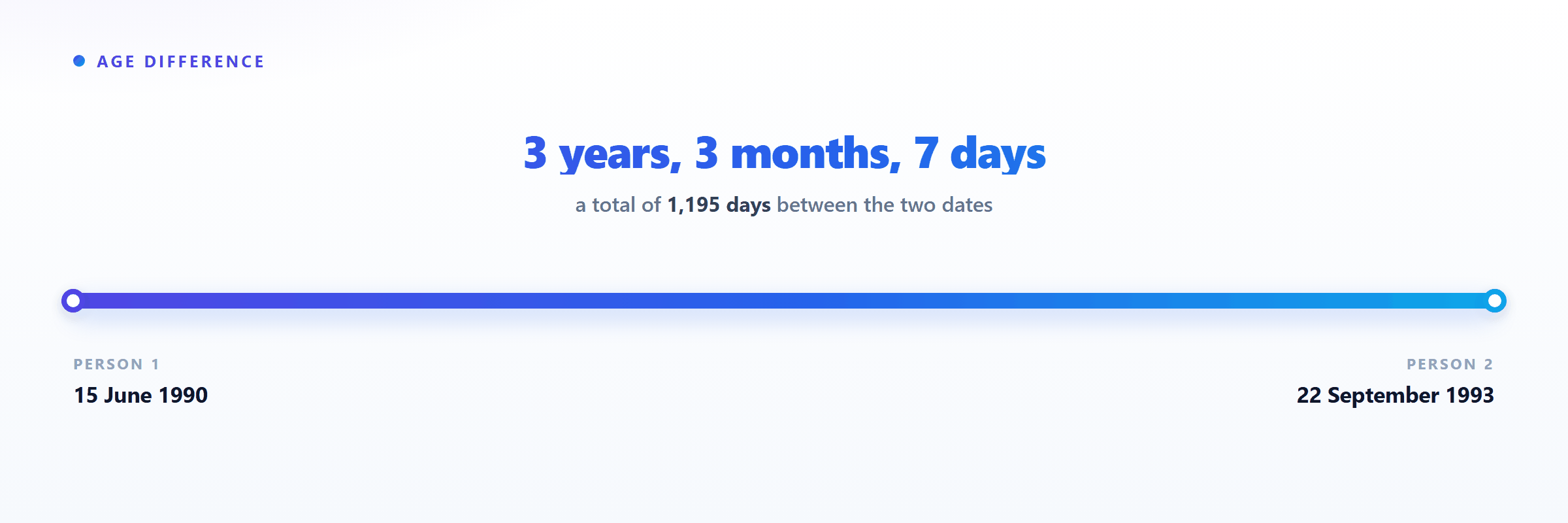
Written out for a real pair of dates, it looks like this. Take 15 June 1990 and 22 September 1993. Days: 22 − 15 = 7. Months: 9 − 6 = 3. Years: 1993 − 1990 = 3. Nothing needed borrowing, so the age difference is 3 years, 3 months and 7 days — 1,195 days in total.
Borrowing appears the moment the day numbers run the wrong way. From 15 January 2000 to 10 March 2000 the day subtraction is 10 − 15, which is negative. The calculator borrows one month's worth of days and returns 1 month and 24 days.
Month-end dates are the one place where calculators genuinely disagree, because there is no valid "one month later" for 31 January in a common year — 31 February does not exist. Rather than round to an approximate month, this calculator reports the honest figure: 29 days from 31 January to 1 March, or 30 days when the year is a leap year. If a question like that one is nagging at you, the guide to how leap years affect age goes through the reasoning step by step.
Age Difference Examples You Can Check
Click any example to try it:
Every figure below comes from this calculator, so you can reproduce them by entering the same dates. Click any card above to load it straight into the form.
| Person 1 | Person 2 | Age difference | Total days |
|---|---|---|---|
| 15 June 1990 | 22 September 1993 | 3 years, 3 months, 7 days | 1,195 |
| 1 January 1985 | 31 December 2000 | 15 years, 11 months, 30 days | 5,843 |
| 5 January 2010 | 10 March 2010 | 0 years, 2 months, 5 days | 64 |
| 29 February 2000 | 1 March 2004 | 4 years, 0 months, 1 day | 1,462 |
| 3 November 1978 | 3 November 1980 | 2 years, 0 months, 0 days | 731 |
The leap-day row is the interesting one. Someone born on 29 February has no anniversary in three years out of four, and the calculator resolves it by treating 1 March as the point at which a full year has passed. The final row needs no borrowing at all, which makes it a useful sanity check: a difference of exactly two years comes back as exactly two years, with zero months and zero days.
What Counts as a Normal Age Gap?
Most people who open an age difference calculator are quietly checking a relationship, so it helps to know what the data actually shows. Pew Research Center's analysis of U.S. Census Bureau data found that in 2022, 51% of opposite-sex marriages had spouses who were within two years of each other in age, and the average gap was 2.2 years. Gaps of two to five years are extremely common and rarely attract comment. Our guide to the normal age gap in a relationship looks at the wider picture.
Larger gaps are less frequent but hardly rare. The same analysis found that 40% of marriages had a husband three or more years older, and 10% had a wife three or more years older. The old "half your age plus seven" formula is folk etiquette rather than a finding from research, and it is best treated as a conversation starter. Numbers also miss the part that matters more: whether two people are at a similar stage of life, want the same things, and enjoy each other's company.
Age difference matters outside relationships too. Siblings born three or four years apart usually pass through school with almost no overlap, while siblings born 18 months apart often land in the same year group. In age-bracket sport, places are normally allocated by birth year, so a player born in December can be nearly a full year younger than a team-mate born in January of the same year.
- Source: Pew Research Center, A growing share of U.S. husbands and wives are roughly the same age (2024), based on U.S. Census Bureau data.
Age Difference Calculator FAQ
How accurate is the age difference calculator?
It is exact to the day. The calculator uses calendar-based date math that correctly handles leap years and months of different lengths, the same method used to compute a single person's exact age.
Does the order of the two dates matter?
No. The calculator automatically detects which birth date is earlier and reports who is older, regardless of which field you fill in first.
What is a normal age gap in a relationship?
In the US, about 51% of opposite-sex marriages have spouses within two years of each other in age, and the average gap is 2.2 years. Gaps of two to five years are common and rarely cause comment.
Can I calculate the age difference between more than two people?
This tool compares two people at a time. To compare a third person, run the calculator again using one of the previous dates.
How do I calculate an age difference without a calculator?
Subtract the earlier date from the later one, starting with the days, then the months, then the years. If the day or month result comes out negative, borrow from the next unit. It takes about a minute and is easy to get wrong across a leap year, which is why most people let the tool do it.
How does the calculator handle a 29 February birthday?
In a common year there is no 29 February, so the calculator treats 1 March as the first day after the anniversary. Someone born on 29 February 2000 therefore completes each full year on 1 March in the three non-leap years, and on 29 February in leap years.
What is the difference between an age difference and an age gap?
Nothing — they describe the same thing. The term age gap is more conversational and is used most often about couples, while age difference appears more in formal and statistical writing.
Can I use this calculator for something other than people?
Yes. It compares any two dates, so it also works for the age of a document, the time between two events, or the gap between a pet's birth date and today. For spans that are not birthdays, leave the name fields empty.
Is my data stored or shared?
No. The calculation happens entirely in your browser and neither date is transmitted anywhere. Nothing is saved between visits, and there is no account or sign-up.